
Agents Patch Last: What the eMudhra Break Reveals About How Machines Trust
· 7 min read · Joel Estibeiro
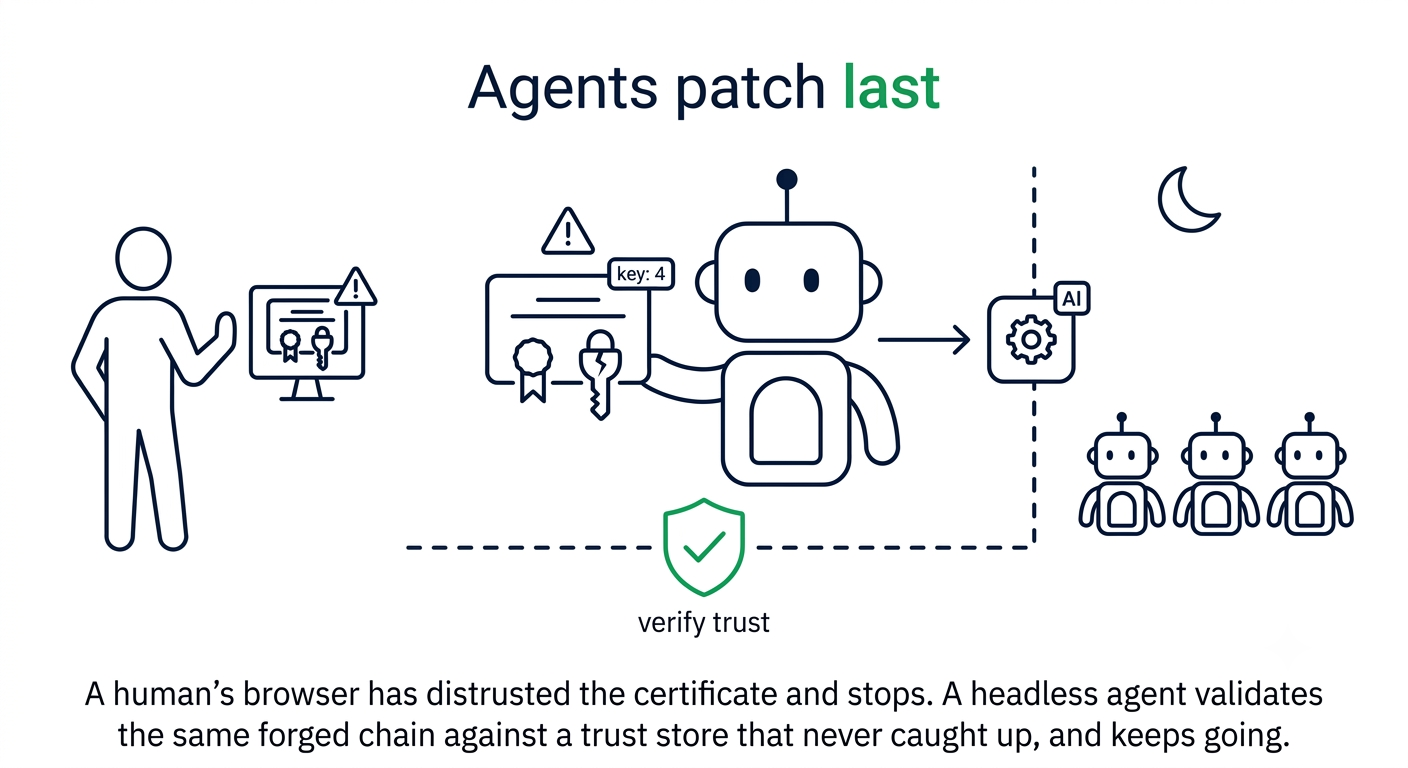
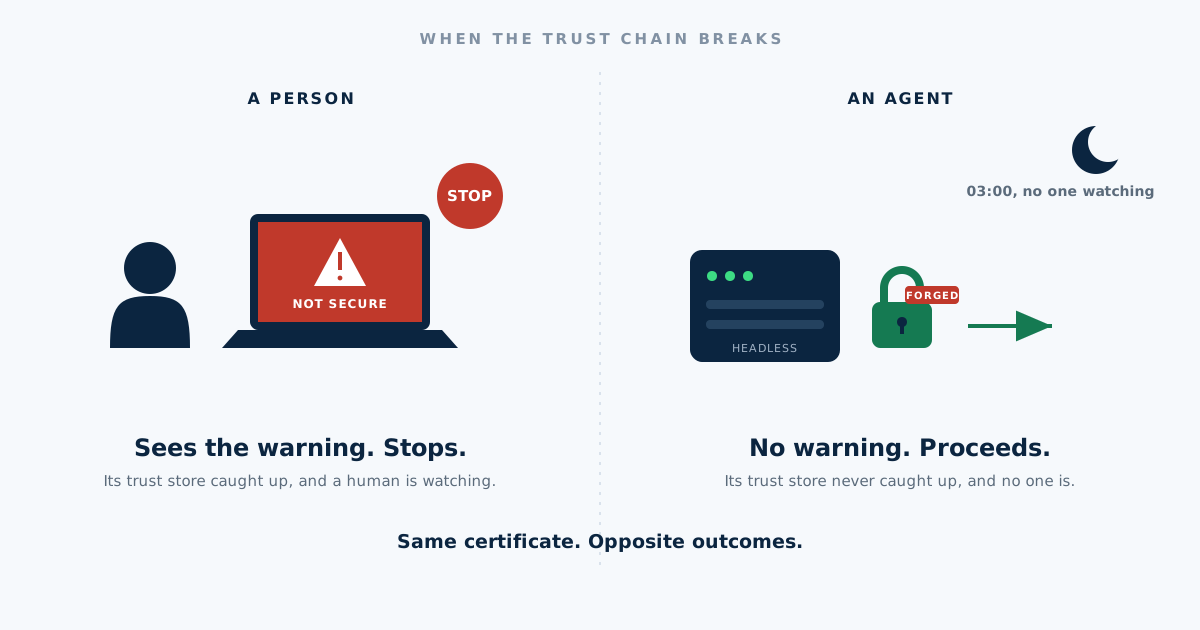
Picture the last time a browser threw a full-page certificate warning in your face. Red background, stern language, a button you had to go looking for to proceed anyway. You stopped. That ugly, friction-filled moment is one of the quiet triumphs of web security: when a certificate is finally flagged as untrustworthy, a human is standing right there to catch it.
Now picture the same certificate, after the world has moved to distrust it, reaching an autonomous agent at three in the morning, mid-task, with no one watching. No red screen, no button, and no rejection either: the agent validates the chain against a trust store that hasn't caught up, finds it perfectly acceptable, and keeps working. The update that stopped you never reached it.
That gap, between how people establish trust and how machines do, is the real lesson of the eMudhra certificate compromise. The incident was almost comically simple. Its implications for the systems we are rushing to deploy are not.
A certificate authority that forgot to be secret
In mid-October 2026, a researcher reviewing the public certificate database noticed something absurd about eight of eMudhra's intermediate certificate authorities. Their P-384 private keys weren't the unguessable 384-bit numbers that the entire system assumes. They were small integers, every one of them below 256. One, as The Register reported, "was the number 4."
A certificate authority rests on exactly one promise: only the CA knows its private key. Reconstructing a strong key from the public certificate is computationally hopeless. That is the whole point. Reconstructing the number 4 is not. Anyone could recover these keys from public data in well under a second, and from that moment become the authority: able to mint a valid certificate for any hostname they liked, chaining cleanly up to a root that operating systems and browsers trusted.
The ecosystem responded the way it is built to. Mozilla moved to distrust the emSign ECC Root CA - G3; Chrome scheduled the root's removal for late October; Apple and Microsoft blocked the affected intermediates; the Go project shipped a standard-library fix to reject them. Within days, as The Hacker News and Help Net Security both documented, a person hitting an affected site would be stopped cold by a warning.
For browsers, this was a bad week that ended. For agents, the week hasn't started.
The real controls were a fresh trust store and a human
We have spent thirty years hardening TLS, and it is easy to forget that two parts of what protects us were never cryptographic. The first is how fast the trust store updates: a forged certificate chaining to a still-trusted root validates cleanly and shows a padlock, fooling a person and an agent alike, until the ecosystem distrusts that root and the decision propagates. The second is the human in front of the screen, who can read the warning that update produces and stop.
A browser gets the strong end of both. Its trust store refreshes within days, so the certificate that looked fine yesterday throws a full-page warning today, and a person is right there to heed it. Autonomous agents get the weak end of both. An agent calling a model, fetching a document, or negotiating with a tool server verifies against a trust store that may be months out of date, with no one positioned to notice if something is off. When its validation does fail, it tells no one; it drops the handshake into a retry loop or a log line read long after the fact. A chain that validates is, to the agent, the end of the conversation. A chain that does not is just an exception nobody reads.
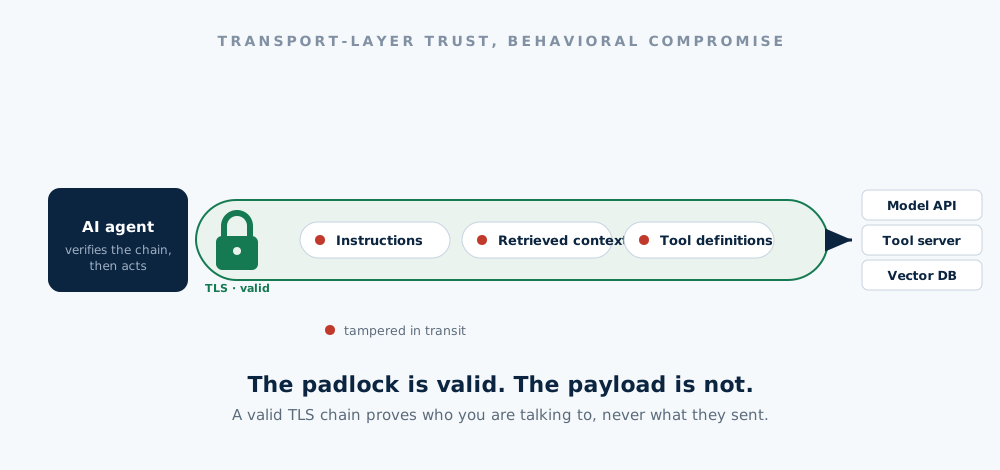
And the stakes of a hijacked connection are higher, not lower. Sit between a person and a web page and the most you control is what the page says. Sit between an agent and the services it depends on and you control the instructions it follows, the knowledge it reasons over, and the tools it believes it has. A transport-layer compromise becomes a behavioral one: tampered text arriving over a trusted channel is indistinguishable, to the model, from legitimate text, so the usual catalog of agent failure modes (instructions smuggled into content, poisoned retrieval, manipulated tool definitions) can all be delivered with a valid padlock attached. The industry has been filing certificate hygiene and prompt injection in separate drawers. This incident is a reminder that they are the same drawer.
Agents patch last
Here is the part that should keep architects up at night, and it has nothing to do with eMudhra specifically. It is structural.
Browsers dropped the compromised root in days because browsers update aggressively and share the operating system's trust store, which is maintained by people whose full-time job is maintaining it. Agent infrastructure works nothing like that. The trust store an agent actually consults is whichever one is frozen into:
- a container image built once last quarter and running untouched since;
- a compiled binary produced before the fix existed;
- a pinned dependency bundle, a language runtime's bundled CA list, locked in a lockfile, updated only when someone remembers to;
- an edge or embedded agent that updates rarely, if it updates at all.
Every one of those keeps trusting a dead root long after the laptop on your desk has moved on. The exposure window for a browser is measured in days. The exposure window for a fleet of agents is measured by its slowest, least-maintained runtime, and in practice that is weeks to months. Agents are the long tail of certificate distrust, and the tail is where attackers live.
Reactive defense is the wrong shape for autonomous systems
Step back and the deeper problem comes into focus. Nearly every defense that "worked" here was a blocklist: discover the compromise, attribute it, publish a distrust decision, and wait for every client to pull the update. That pipeline is elegant for a population that updates in days and nearly useless for one that updates in months.
And a blocklist can only react to the compromise you already know about. The exposure lives in the interval between the attacker having the key and the ecosystem publishing the distrust. For browsers that interval closed fast. For agents it stays open, and it stays open regardless of how quickly researchers move, because the limiting factor isn't discovery, it's the rebuild. We have built our most autonomous systems to depend on the least autonomous part of the trust model.
What the industry should actually change
None of this requires exotic technology. It requires treating an agent's trust decisions as first-class security surface instead of an assumed-solved detail. A few principles worth adopting broadly:
- Make trust-store freshness a release gate. If a service builds its own view of which certificate authorities are legitimate, that view has an expiry date. Treat a stale trust store the way you treat a stale dependency with a known CVE, because that is exactly what it is.
- Let verification ride the system trust pool. Freezing a custom CA bundle into an image is how you end up trusting a revoked root forever. Deferring to the platform's maintained trust store means an operating-system update actually reaches your agents.
- Treat the agent-to-service channel as a boundary, not a solved problem. TLS terminating successfully is the beginning of the trust question for an agent, not the end of it. The links to models, tool servers, and retrieval systems deserve monitoring, not blind faith.
- Judge certificates on properties, not just reputation. A distrust list tells you about yesterday's known-bad authority. An intrinsic check, asking whether this key is absurdly weak or whether this destination's issuer has suddenly changed, can flag tomorrow's on day zero, before anyone has published anything.
- Watch Certificate Transparency and pin the hops that matter. For the connections an agent cannot afford to have silently redirected, continuity and pinning turn "trust whoever signs" into "trust the identity we've actually seen."
- Put the checks in the path, not just in the policy. None of the above enforces itself; something has to sit in the agent's outbound path to do it, because a policy document cannot inspect a handshake. In practice that means a lightweight control at the endpoint, one that terminates and inspects an agent's own connections, judges the certificate on its properties rather than its reputation, and can block or rewrite a tampered prompt, a poisoned retrieval, or a swapped tool definition in real time, before the model acts on it. This class of control is no longer hypothetical; the harder problem is deploying it across your agents before an incident makes you wish you had.
The uncomfortable truth underneath all of it: we are deploying systems that make consequential decisions, at machine speed, with no human positioned to notice an impostor behind a valid padlock, and we are defending them with a model that assumed a human always would be. eMudhra's keys will be distrusted and the incident will fade. The structural gap it exposed will not, until we stop treating the warning nobody is left to read as if it were still doing its job.
So ask the question for your own fleet, because no vendor advisory will ask it for you: when did your agents last refresh what they trust, and if one of them were talking to an impostor right now, is there anything, or anyone, positioned to notice?
Sources: The Register, Mozilla Security Blog, The Hacker News, Help Net Security.