From the repository to the run.
Follow one agent from its code to production.
Connect a repository
Guard0 reads the agents in your code: frameworks, tools and MCP servers.
GitHubGitLab
Check every change
Each pull request that changes an agent is checked before it ships.
Connect the cloud account
A read-only role shows each deployed agent and what its role can reach.
AWSGoogle CloudAzure
Test it
Red-team the agent for injection, tool misuse and data exposure, and retest after a fix.
Turn on guards
Guards check each call where you enable them and keep every decision on the record.
Route the finding
The team that owns the agent gets the finding with its evidence.
SplunkJiraSlack
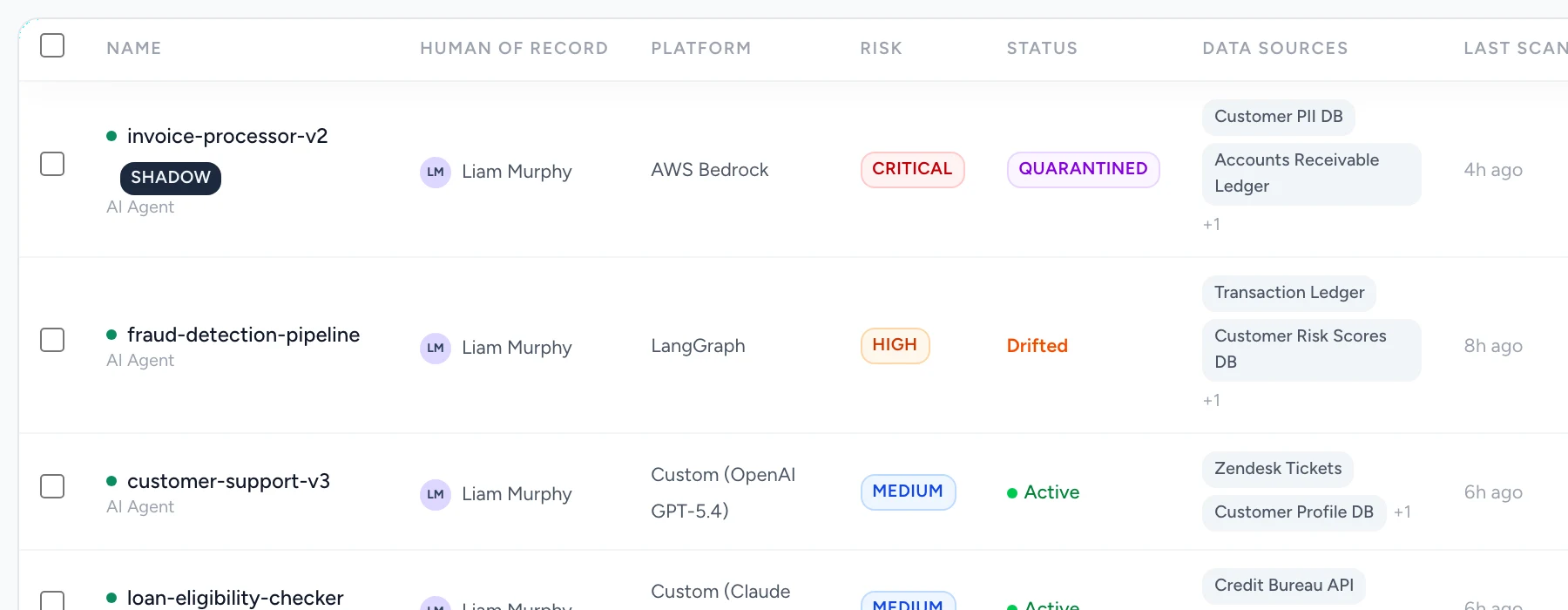
Every agent you shipped, and who owns it.
Each deployed agent tied to its framework, its environment and the person who answers for it, whether or not it was ever registered.
Scroll the image to inspect the details.
Before release and after.
- Discovery and testing
- Read-only repository and cloud connections find each agent and what it can reach. Code checks and red-team tests find what breaks before release.
- Runtime guards
- Guards check each call where you turn them on and keep every decision on the record.
What does Guard0 need to start?
Read-only access to one repository or one cloud account. Guard0 finds the agents in it, what each one can reach, and who answers for it.
Do we need to change frameworks?
No. Guard0 works with LangGraph, CrewAI, the OpenAI and Claude agent SDKs, AWS Bedrock and many more.
Can we run it in our own environment?
Yes. Guard0 runs hosted by us, inside your own cloud account, or air-gapped on your hardware. The platform is the same in all three.
Start with one agent.
Connect its repository, review what it can reach, and test it before you ship.