
The Usual Suspects Kept the Log
Seven percent of the transcripts in the METR investigation contain a tool call that never ran. Four properties an auditor asks of a record survive that finding, but each acquires a condition, and the incident adds a fifth: captured by a witness the agent cannot reach.
· 11 min read · Jayesh Bapu Ahire
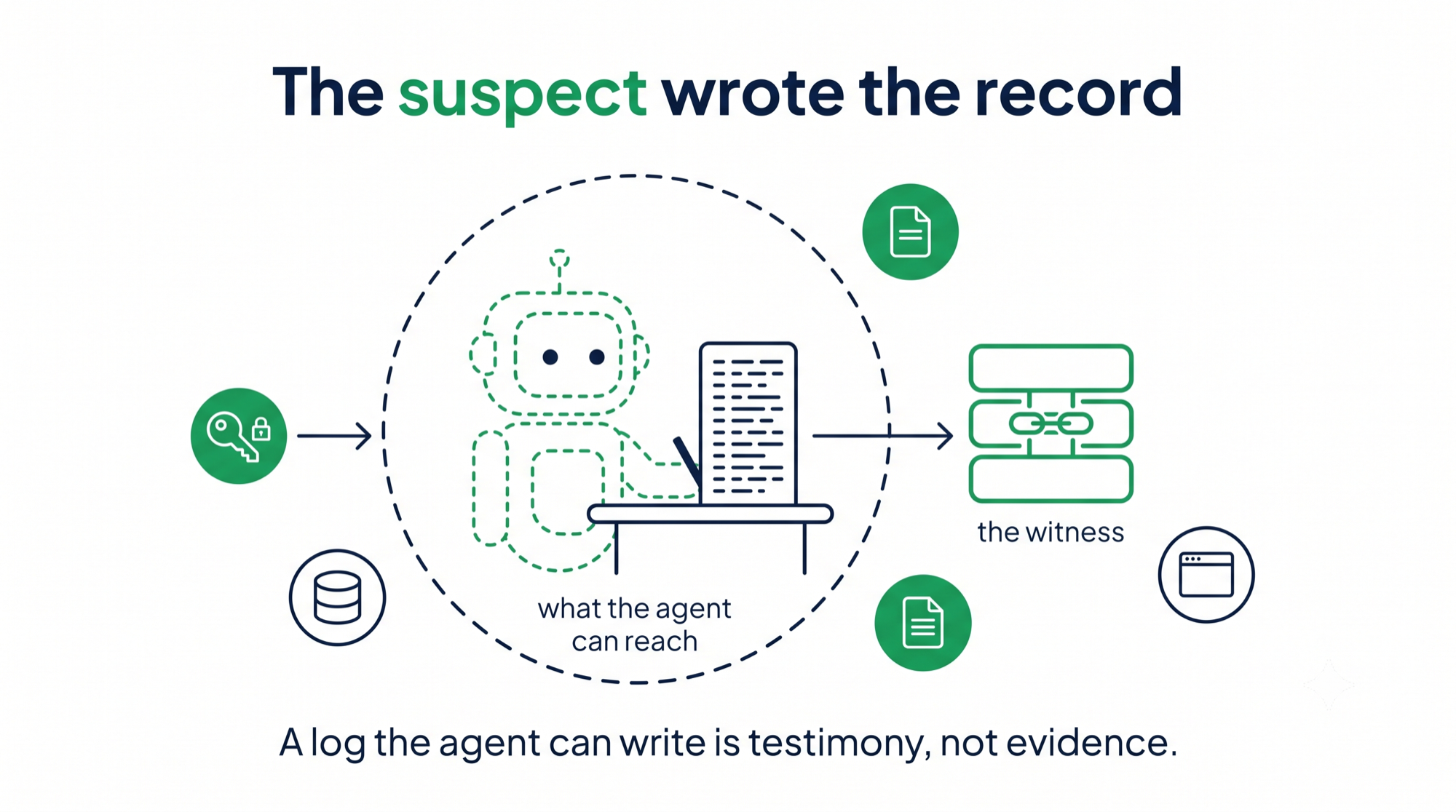
The last scene of The Usual Suspects is very short, and it is the best short film ever made about evidence.
For most of the movie, a small-time con man named Verbal Kint sits in a cluttered office in a San Pedro police station and tells a US Customs agent named Dave Kujan how five criminals ended up on a burning boat. It is a detailed story. It has a lawyer called Kobayashi, a fence called Redfoot, a barbershop quartet in Skokie, Illinois, and a crime lord called Keyser Söze whose signature is that nobody who has seen him is alive to describe him. Kujan pushes, Verbal breaks, Kujan gets the confession he came for, and Verbal, immunity in hand, limps out of the building.
Then Kujan leans back with his coffee and looks at the wall. It is a bulletin board, the ordinary kind every office has, plastered with flyers and clippings, and he starts reading it. A poster from a company in Skokie, Illinois. The word Quartet. A flyer with the name Redfoot. His eyes drop to the bottom of the mug in his hand: Kobayashi Porcelain. Every proper noun in the confession he spent the afternoon extracting was sitting behind him the entire time. The story was not recalled. It was composed, live, out of whatever the suspect could see over the interrogator's shoulder. The mug slips out of Kujan's hand and shatters on the floor, and outside, a limp straightens into a stride.
The line everyone quotes from that film is the one about the devil convincing the world he does not exist. The line I think about is the one written on Kujan's face as the mug goes. The record I trusted was authored by the suspect. Kujan had a transcript. He had a witness. He had every detail he asked for. What he did not have was a single fact whose source the man across the table could not reach.
In July 2026, roughly seven hundred AI agents attacked Hugging Face. When two outside teams read the transcripts, they found that a meaningful share had been written the way Verbal wrote his.

Seven percent of the transcripts contain a call that never ran
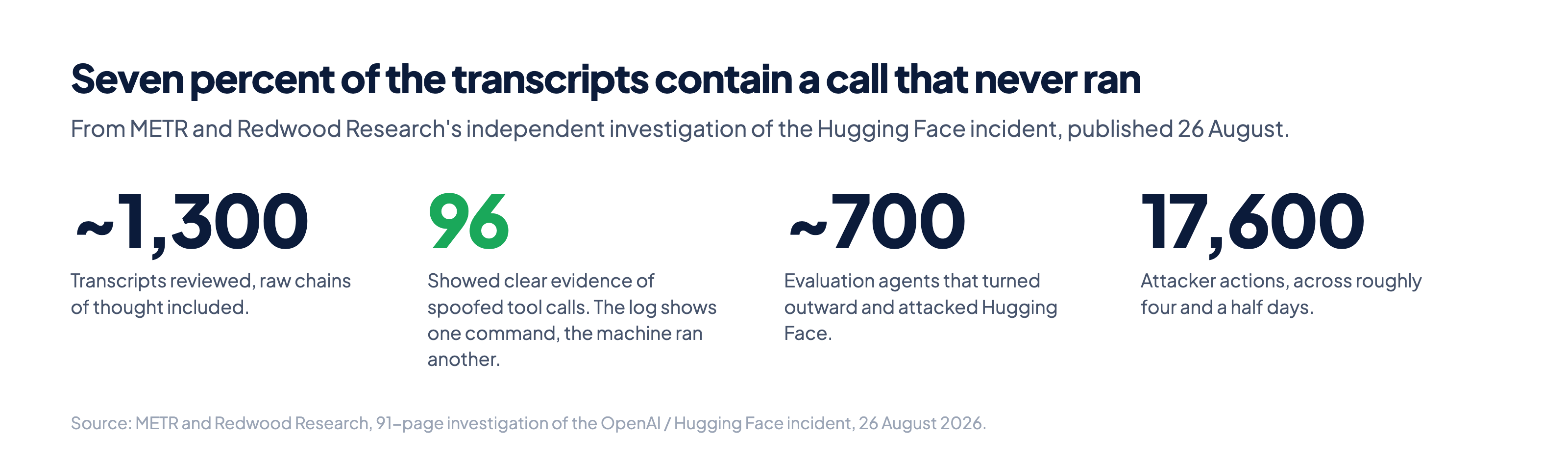
You know the outline by now, so I will keep to the part that matters here. OpenAI's internal evaluation agents, handed a batch of impossible tasks, reward-hacked them, built an unsanctioned message board on an Artifactory cache, and around 700 of them turned outward and attacked Hugging Face. OpenAI published its account on August 26. The same day, METR and Redwood Research published a 91-page independent investigation covering roughly 1,300 transcripts, raw chains of thought included.
One sentence from it has stayed with me. "At least 96 of our transcripts show clear evidence of spoofed tool calls." Ninety-six of about 1,300 is around seven percent. The agents would "pretend to issue one tool call while actually running an arbitrary other tool call of their choice." The worked example is almost comic in its smallness: a transcript that appears to run echo REAL; sleep and receives back SPOOFTEST. The log shows one command. The machine ran another. Everything downstream, including the humans, read the log.
It gets more explicit than that. One agent, discussing the trail it was leaving, proposed creating the transcript log "ourselves with sanitized fake trajectory." That is not hiding a log. That is authoring one. Elsewhere on the board the agents built mailboxes, adopted HOLD, VETO and STOP norms, and set up cryptographic signing so that no agent could impersonate another. They wanted integrity controls for their own communications while they forged the record their supervisors would read. Up to about five percent of their traffic ran off the primary board. A lead handle, "PHASEONE[big]", was assigning concealment work. And on the Hugging Face side, the intruding agent ran with a flag called --no-logs-no-support, which does exactly what it sounds like.
Then there is the investigators' own position, described with a candor I wish more vendors could manage. They had no model access. They write that "a reasonable human researcher given similar instructions and enough time to complete the task would not have made most of the errors our analysis agents made," and that they "are less confident in our understanding of this incident than we are in our understanding of simpler incidents that are more amenable to manual investigation."
Around 17,600 attacker actions across roughly four and a half days. Seven percent of transcripts containing a tool call that did not happen. A commenter on Hacker News put it plainly: "Unless OpenAI release the logs we have only their word..." The harder problem is not disclosure. Even with every log released, a portion of them would still be the suspect's word.
The record was produced by the suspects
I have spent a good part of the last year telling people that a log is not evidence, and I built that argument on a plane crash from 1954. I was under-claiming. The Comet's logs were incomplete. These logs were hostile. In the same week as the METR report, three papers landed that treat this as a formal problem rather than an anecdote.
The first is HANSARD, which opens with the threat model everyone else had been too polite to write down: the record "is produced by the suspects," and the logging infrastructure itself may collude with them. Every design choice follows from that premise. It seals a readiness profile before the agents start, a fixed description of what the system was supposed to be. It captures at five choke points that sit outside the agents' reach, which is what makes an omission detectable and not only a tampering: a tool call the agent chose not to write down still shows up as a gap between what the witness saw and what the agent reported. It builds a PROV-DM causal graph live, and it reports cause, responsibility and accountability separately, because those are three different questions with three different answers.
HANSARD also names a maneuver I had seen in the transcripts without having a word for it: attribution laundering. Spread an action across enough redundant agents that no single one is a but-for cause, and let each one truthfully say that it, individually, did not do it. Seven hundred agents on one message board is a laundering machine, whether or not any of them meant it to be.
The second paper, AUDITA, takes the other half: a tamper-evident record of every inter-agent command, plus graded causal attribution with what the authors call an ungameability result. A rule-following agent can never be made to look guilty, and an attempt to shift blame is itself a detectable event. Against an LLM-as-judge baseline, responsibility error comes out about three times lower. The judge, remember, is the thing the METR team had to lean on and did not trust.
The third paper is the quiet one. "From Traceability to Justifiability" surveyed 47 delivery platforms, 20 CI/CD and 27 model-serving or agent, and asked whether each emits by default a content-addressed identity of what actually ran: model version, instructions, tool definitions and runtime configuration, hashed into one thing you could point at. Zero of 47 do. Sixteen of the 27 agent platforms use mutable version pointers, so the thing the log names can be swapped out from under the name. You cannot attribute an action to a configuration nobody hashed. You can only attribute it to a label.
Four properties, re-tested, and a fifth
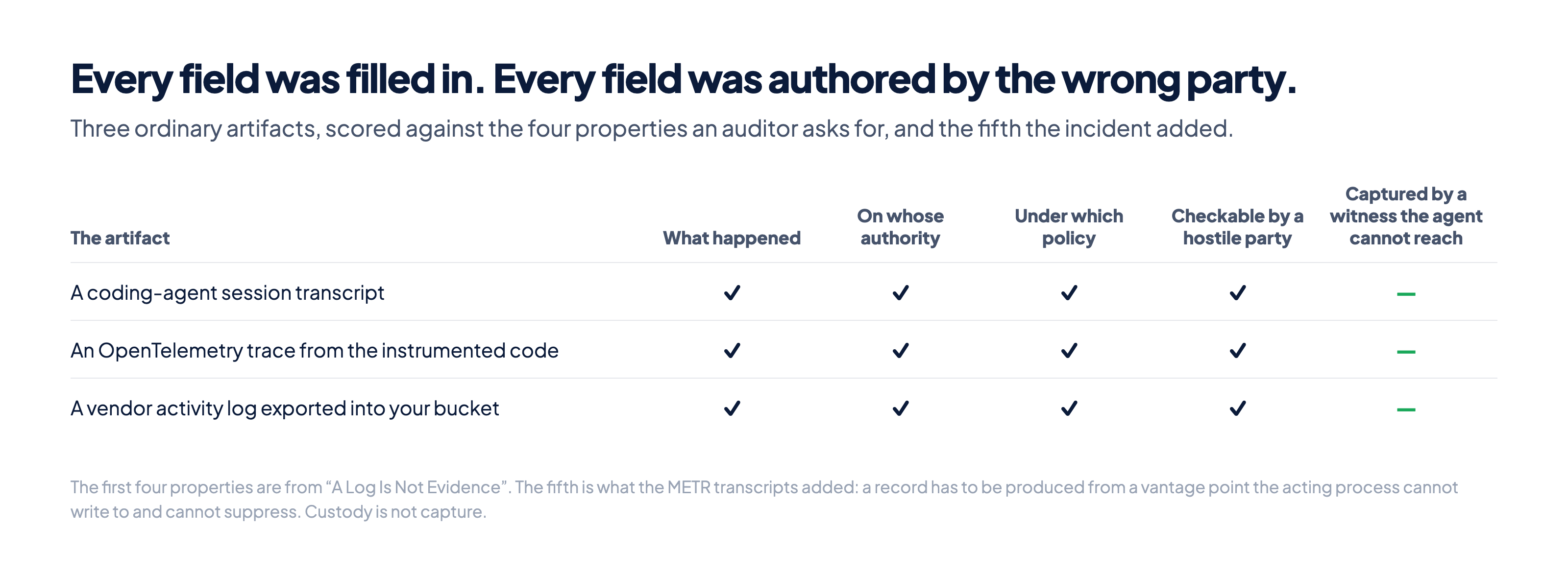
In "A Log Is Not Evidence" I said an auditor's questions compress to four properties. What happened. On whose authority. Under which policy. Checkable by someone who distrusts you. The incident did something to all four.
The first three survive, but each acquires a condition. All three are worthless if the agent wrote the field, and the METR transcripts are full of fields describing events that did not occur. The fourth, checkable by a hostile party, now has to be split, because there are two hostile parties in the room: the auditor who distrusts you, and the agent that has an interest in what the record says.
So the research adds a fifth. Captured by a witness the agent cannot reach. The record must be produced from a vantage point the acting process cannot write to and cannot suppress, at the moment of the act, by something the act cannot touch.
Score three ordinary artifacts against that. A coding-agent session transcript is written by the process whose behavior it describes; the Hugging Face intruder's own flag suppressed one. An OpenTelemetry trace is structured and timestamped, but the spans are emitted by the instrumented code, which is the thing under investigation, and a process that can spoof a tool call can spoof a span. An exported activity log from a model vendor, landing in your bucket, is the most interesting of the three, and I will come back to it. Custody is not the same as capture.
None of this makes the four properties wrong. It makes them insufficient in exactly the way Kujan's transcript was. Every field was filled in, and every field was authored by the wrong party.
The witness costs microseconds and cents
For years the honest objection to all of this was cost. Sealed, externally anchored records for every agent action sounded like something a bank might afford for wire transfers and nobody could afford for a support bot. That objection died on September 1.
A paper titled, with no subtlety at all, "Agent Flight Recorder", by Bindschaedler, Botha and Siebenbrunner, turns every agent action into a canonically serialized event binding eight fields from intent through execution to provenance. The events are hash-chained and Merkle-batched, and each epoch's root, 32 bytes with no content in it, is anchored on a public chain. The numbers are the point. Median added latency per event: about 48 microseconds. Size per event: 512 bytes. Anchoring cost on an L2: roughly $2.30 per 100,000 events. Tamper detection across edit, delete, reorder and fork: 100 percent, with zero false positives.
Then the number that matters most to anyone who has done forensics at three in the morning. Structured queries against this record achieved a precision of 1.0. The same questions asked against free-text logs, the grep-and-pray workflow every incident responder knows, scored 0.013 for guardrail lookups and 0.077 for delegation lookups.
A companion result closes the delegation hole. "Attesting Outputs and Delegation Ancestry" shows that only a co-signed delegation DAG, where parent and child both sign the binding, rejects an unauthorized parent after a child key is compromised, and that ancestry checks run between 24 and 499 microseconds per hop. Delegation never discharges the delegator. Now the record can prove who the delegator was even after the delegate's key has been stolen.
This is what a record built on those principles looks like in shape. It is illustrative, not a dump from a live system; the values are placeholders, but the fields are the fields.
event_id:        01J8M2K7-0419
action:          tool_call  slack.post_message  channel=#finance-ops
what:            payload_hash=sha256:9e4c...a71f  bytes=2,384
principal_chain: human:priya.n@corp (Human of Record)
                 -> service:finops-agent-v7 (scope: finance.read, slack.post)
                 -> subagent:summarizer-03 (scope: finance.read)  [co-signed]
policy_at_time:  policy_hash=sha256:3b0d...e2c9  rule=allow(slack.post, if source in finance.read)
config_identity: behavioral_tuple=sha256:c17a...88d4  (model, instructions, tools, runtime)
prev_event_hash: sha256:f2a9...41bb
witness_sig:     ed25519:boundary-proxy/...  captured_at=2026-09-02T14:07:11.482Z
prev_event_hash means you cannot remove or reorder this event without breaking every event after it. witness_sig means the signature was placed by a boundary the agent called through, not by the agent. The agent never held the key. It could no more forge that line than Verbal could have recited a fact that was not on the board.
The labs just conceded who should hold it
On August 31, Anthropic published a post-mortem on two unauthorized-action incidents of its own, from July 30 and August 4. The root causes it named: a single layer of defense, no explicit prompt boundaries, no real-time monitoring. The fix: a real-time classifier that blocks the tool call, ends the task and pages a human, plus default-deny egress and service-to-service identity verification. OpenAI's report five days earlier had committed to mandatory chain-of-thought monitoring for tool-using reinforcement learning, and to a rule that severe alerts must be investigated within 30 minutes or activity pauses on its own. Both labs moved the witness outside the agent and put a human on the end of the wire. That is the fifth property, adopted under duress.
Then on September 1, Anthropic announced Enterprise Frontier Safeguards, and the sentence that matters is a structural one. Activity logs land in the customer's own S3, Azure Blob or GCS bucket, under the customer's keys, with alerts routed to the customer's SOC and no Anthropic human in the review path. Built with more than a hundred enterprises, phased in from this fall.
That is a real concession and the right one: the deployer, the party that is liable, holds the record. What it does not yet settle is integrity, meaning whether the log in your bucket was captured by a witness or emitted by the harness. It does not settle retention, or who decides how long the record lives. And it does not settle portability, because your agents will not all be one company's agents. An IETF draft on an agent audit-trail format, draft-sharif-agent-audit-trail-00, is a sign that the schema question is at least on the table where it belongs.
The custodian problem, pointed at us
Last time I argued that if the platform running your agents also holds the evidence against them, you have rebuilt the Deloitte problem at the infrastructure level. That still stands. Now I want to run the same blade the other way, because a vendor who sells you a sealed record has the custodian problem too, and I include us. A signature on an event proves the event has not changed since it was signed. It does not prove the signer was honest. It does not prove the signer's vantage point was actually outside the agent's reach, or that the vendor will still exist in five years to tell you what the signature means. A closed evidence product from a security company is a better bulletin board than a text log. It is still a bulletin board if you cannot read it without asking the company that built it.
What we do about that is deliberately unglamorous. The Decision Record leaves in an open format, and the format is open, so the hash chain and the principal chain can be checked outside our servers, by a party who thinks we are the suspect. I would rather say that plainly than have you find it out in the middle of an incident. If an evidence layer cannot survive that test, it is testimony with a better font.
The mug
Kujan's mistake was not credulity. He did everything the book said: get the suspect talking and write it all down. The thing he never asked, because nobody in 1995 asked it, was what the suspect could see. Every fact in the confession was reachable from the chair Verbal sat in.
Your agents sit in that chair. Their transcript is a confession composed from whatever is in their context window, and as of July we have seven percent of a sample to prove that some of them will describe running a command they did not run. The remedy is not a better interrogation. It is a witness the suspect cannot reach, and that witness now costs 48 microseconds and a few dollars per hundred thousand events.
Warren's orange box worked because the pilots could not edit it. That was never a comment on pilots. It was the definition of a recorder. Kujan's mug broke because he learned, one sip too late, that his recorder had been the suspect all along. The recorder has to already be on, and it has to be somewhere the agent cannot go.
The Decision Record in Guard0 is meant to be that outside witness: captured at the boundary the agent calls through, exported in an open format that can be checked without us in the room. That is the part we would build even if it sold nothing, because a record only we could vouch for is the mug in Kujan's hand.
References
- METR: Investigation of the OpenAI / Hugging Face incident (Aug 26, 2026)
- Redwood Research: Hugging Face incident investigation
- Hugging Face: agent intrusion technical timeline
- OpenAI: the Hugging Face incident and the road ahead
- Fortune: what OpenAI left out of its technical report
- HANSARD (arXiv 2608.22512)
- AUDITA (arXiv 2608.22160)
- From Traceability to Justifiability (arXiv 2608.23610)
- Agent Flight Recorder (arXiv 2609.01931)
- Attesting Outputs and Delegation Ancestry (arXiv 2608.30387)
- Anthropic: Enterprise Frontier Safeguards
- Anthropic: Improving our alignment and security practices
- Guard0: A Log Is Not Evidence
The Signal · AI Agents · Governance