
What is AI agent governance?
AI agent governance is the set of records and rules that make a person answerable for each AI agent a company runs: a register of the agents, a named owner for each one, a policy for what it may do, and a dated decision each time that changes. It applies wherever the agent runs.
Agent governance and AI governance
AI governance programs set policy for models and use cases: which are allowed, and under what review. Agent governance works at the level of the single agent. It records who owns this agent, what it can reach, what it did and who approved each change, which is the evidence an audit asks for.
In the glossary: AI governance
Guide: EU AI Act Compliance for AI Agents: Article 14 and Beyond
Accountability you can actually inspect.
A score with its working: registration, monitoring, governance and compliance, with the gaps behind each.
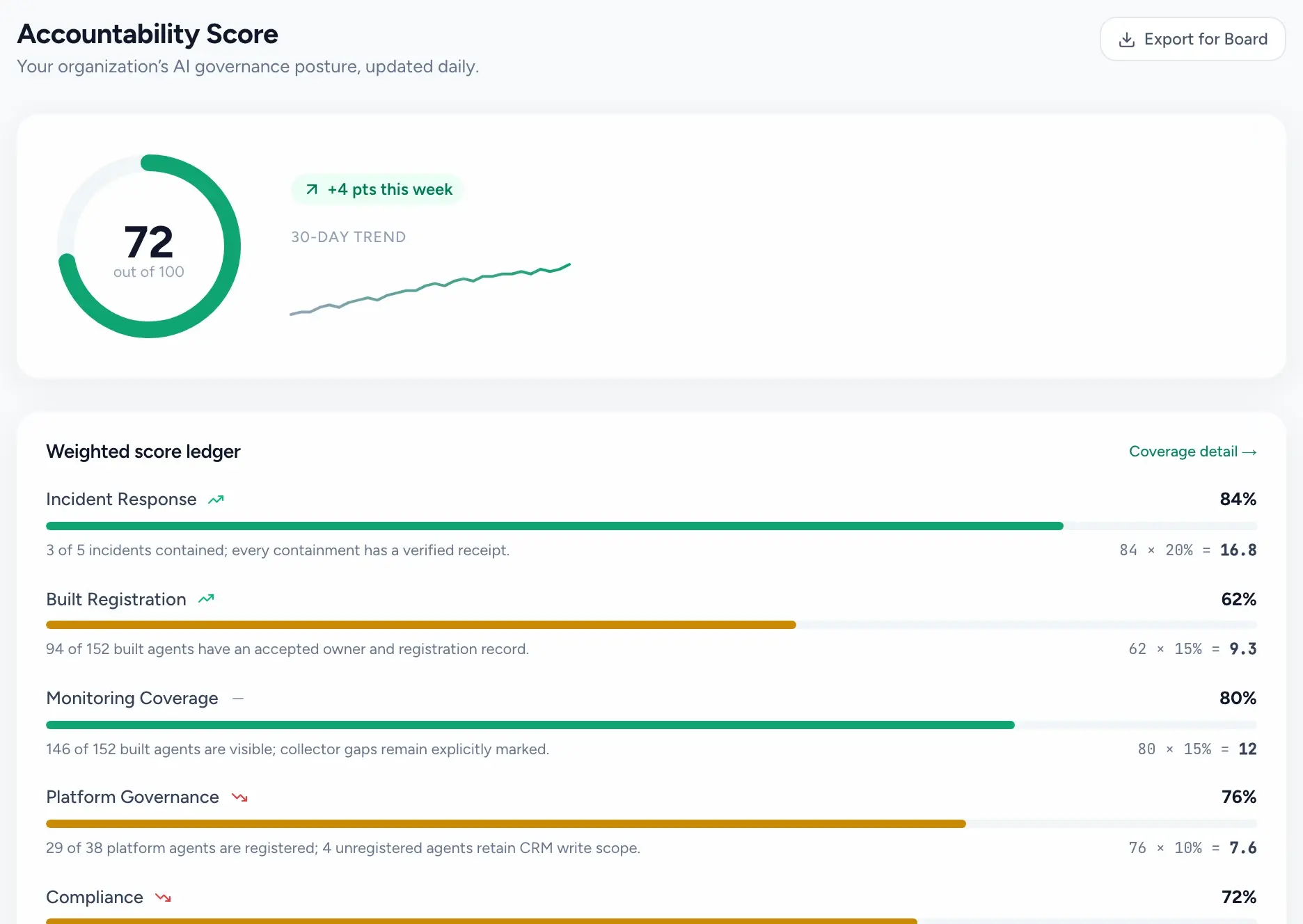
Scroll the image to inspect the details.
Ownership wherever the agent runs.
An owner and a decision for the tools people run.
OpenClaw Gateway carries a recommended decision: move it to organization credentials and revoke its persistent write and terminal grants. Omar Haddad, in IT, answers for it.
More on Workforce AI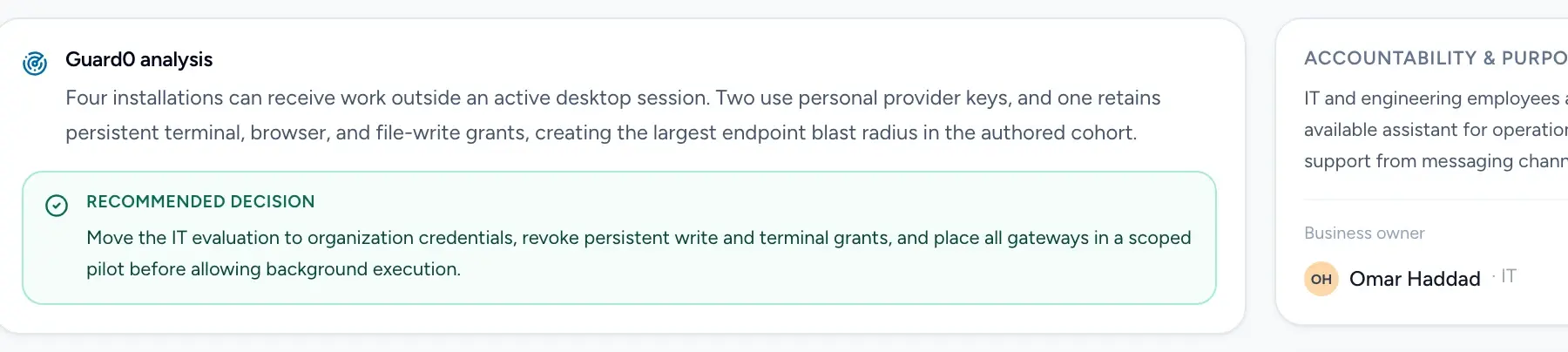
Scroll the image to inspect the details.
80% of organizations have watched an AI agent do something it was not intended to do.
Who owns it, what it may do, and when that was decided.
- A Human of Record for each agent
- A named person, not a team alias, who answers for what the agent can reach and what it does.
- Policies that act
- Post to Slack, open a Jira ticket or page the on-call when an agent breaks a rule.
- Decisions on the record
- Who approved what and when, for every approval, scope change and quarantine.
- Evidence for your frameworks
- Findings mapped to the EU AI Act, ISO 42001, NIST AI RMF and the OWASP Top 10 lists, and many more.
- Offboarding that includes agents
- When someone leaves, their agents are listed in offboarding and move to a new owner.
Common questions
What does AI agent governance require?
Four things for every agent: an entry on a register, a named person who answers for it, a policy that says what it may do, and a record of each decision about it. Guard0 keeps all four in one place for agents on laptops, in platforms and in the code your teams ship.
What is a Human of Record?
The named person who answers for an agent: what it can reach, what it does and the decisions about it. It is a person, not a team alias, and it can differ from the maker who built the agent. Every agent on the register has one, and a policy can require one within a set time.
Which frameworks does Guard0 map to?
The EU AI Act, ISO/IEC 42001, NIST AI RMF, the OWASP Top 10 for LLM Applications, the OWASP Top 10 for Agentic Applications and many more. Each finding carries the framework items it relates to, so the same register answers a security review and an audit without a second inventory.
How does AI agent governance relate to the EU AI Act?
The EU AI Act asks deployers of high-risk AI systems to assign human oversight to named people, monitor the system and keep its logs. Guard0 records the owner of each agent, the policy applied to it, its runs and each decision with a date. Whether a system is high-risk is a legal classification made with your counsel.
What happens to an AI agent when its owner leaves?
Their agents are listed in offboarding and move to a new owner, so no agent is left without one. The change of owner is kept on each agent’s record with its date, and the new owner sees what the agent can reach and the decisions already made about it.
Can a policy act, or does it only report?
It acts. A policy can post to Slack, open a Jira ticket or page the on-call when an agent breaks a rule, and it can require an owner before an agent keeps a permission. In the demo tenant, platform agents that can write to the CRM must have a Human of Record within 48 hours.
Who uses the governance record?
The security team uses it to see which agents have no owner. The agent’s owner uses it to approve scopes and decide on findings. Audit and compliance use it as evidence: who approved what and when, for every approval, scope change and quarantine. All three read the same register.
Evidence for your frameworks
- EU AI Act, Article 26
- Deployers of high-risk AI systems assign human oversight to named people and keep logs. Guard0 records the Human of Record and each agent’s runs.
- ISO/IEC 42001, Annex A.3
- Asks for defined roles and responsibilities for AI. Guard0 records who owns each agent and who approved each decision, with the date.
- NIST AI RMF, GOVERN 1.6 and 2.1
- An inventory of AI systems and documented roles. Guard0 keeps the register and the owner of record for every agent on it.
Start with the agents nobody owns.
Connect one platform or one team and give every agent on the register a person who answers for it.
Free for up to 3 people. No card. Team from $416 a month, billed annually. See pricing
Published Updated