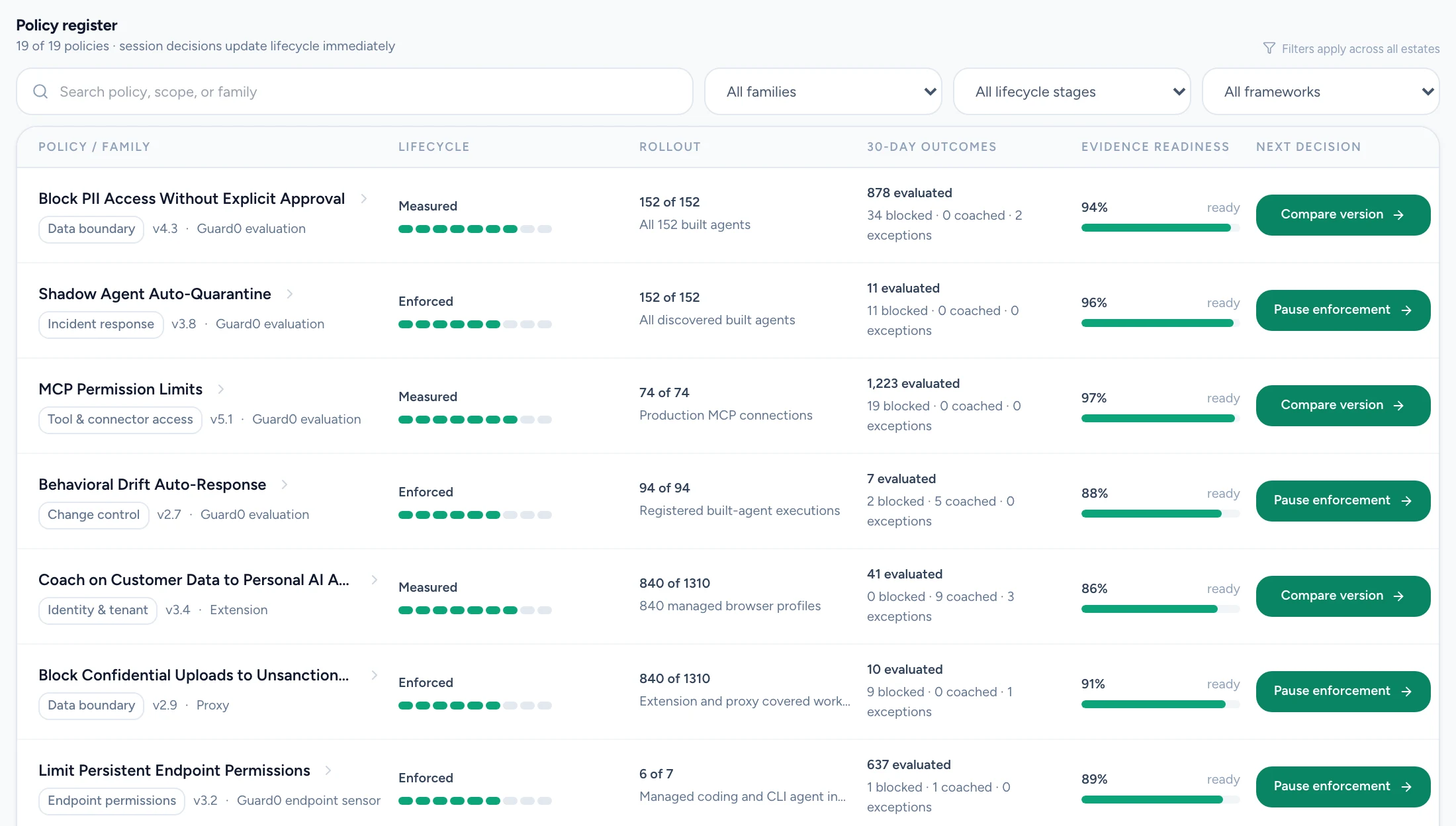
See what your policies actually did.
From evaluation to enforcement: each policy’s rollout, blocked and coached calls, and evidence readiness.
Scroll the image to inspect the details.
What happened, and what the policy did.
Runs with nobody at the desk.
A Telegram message started an unattended incident-triage run on a laptop. It read the engineering workspace and used the terminal, the browser and GitHub. Guard0 records each step and what started it.
More on Workforce AI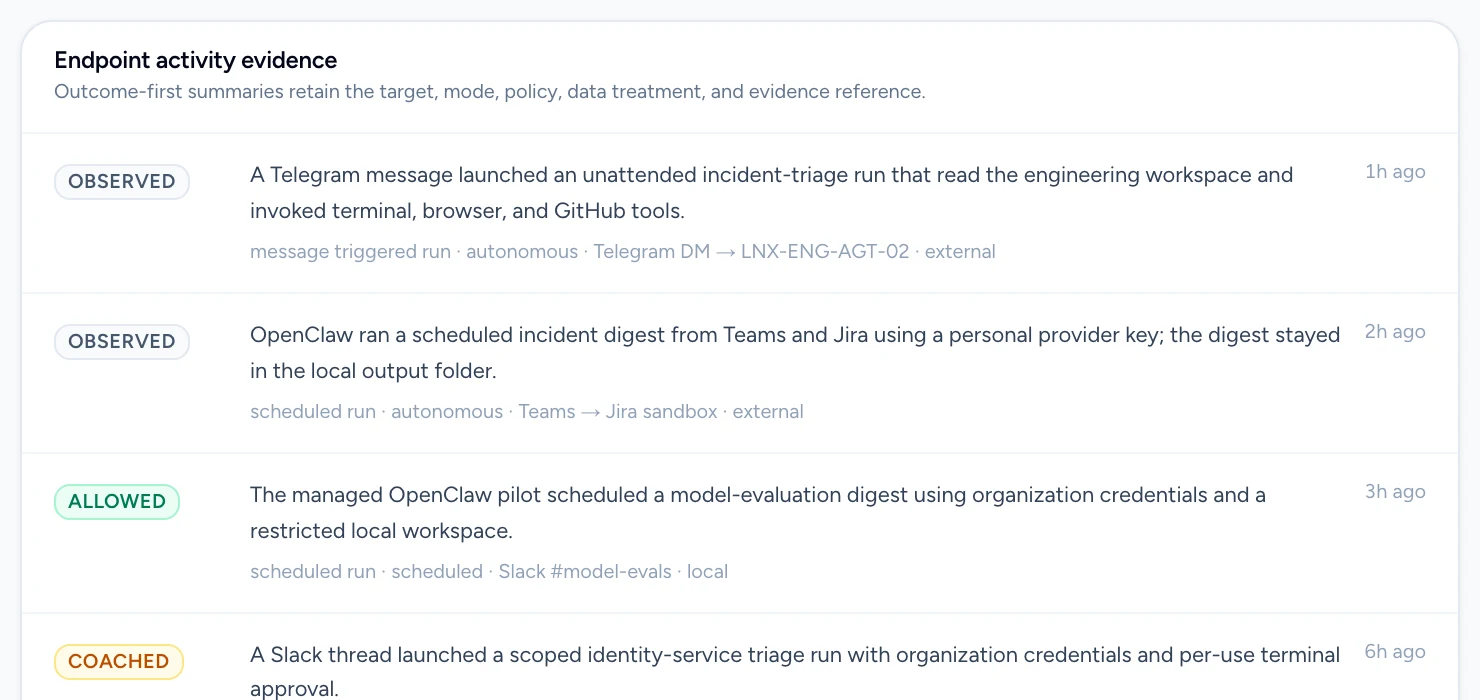
Scroll the image to inspect the details.
Researchers found 120 llms.txt files across 6,214 corporate domains pointing at packages nobody had registered. Coding agents installed what was behind them, and endpoint detection raised no alert.
From the run to the decision.
- Every run, step by step
- What started it, which tools it called and what data it touched.
- A baseline for each agent
- Queries, data processed and writes, measured against what the agent normally does.
- Guards on the call
- Allow, redact, coach or deny at the proxy, the browser extension, the endpoint sensor, the platform’s admin API or a repository hook.
- Quarantine
- Revoke the agent’s credential and block its outbound traffic. The owner is told, and the decision stays on the record.
Common questions
Does Guard0 sit in the request path?
Only where you put a guard. Recording is read-only, and guards run at the enforcement point you choose.
How is this different from EDR?
EDR watches processes. An agent calling an approved API looks normal to it. Guard0 measures each agent against its own baseline and names the person who answers for it.
What does quarantine do?
It revokes the agent’s credential and blocks its outbound traffic. The owner is told, and the decision stays on the record.
Start with the agents already running.
Connect a team, a platform or a cloud account and see each agent’s runs as they happen.